
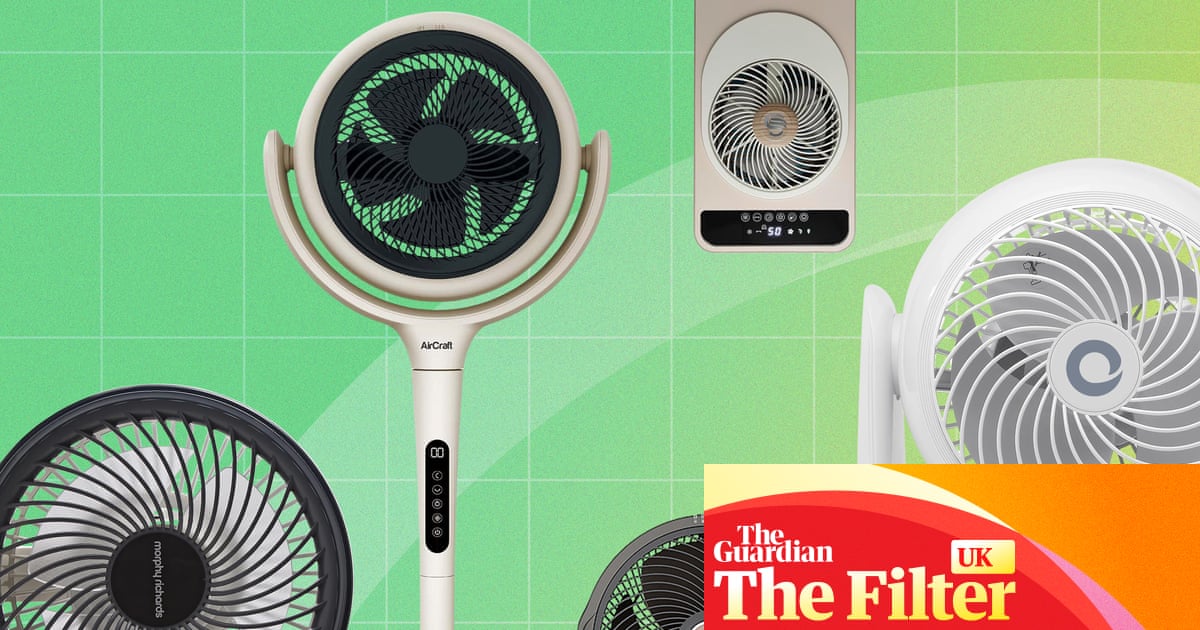
Our world is getting hotter. Summer heatwaves are so frequent, theyâre stretching the bounds of what we think of as summer. Hot-and-bothered home working and sweaty, sleepless nights are now alarmingly common.
Get a good fan and you can dodge the temptation of air conditioning. Aircon is incredibly effective, but it uses a lot of electricity ⦠and burning fossil fuels is how we got into this mess in the first place. Save money and carbon by opting for a great fan instead.
Fans are more energy efficient than aircon. A typical portable air conditioner uses 1,000W of electricity, which would cost about 26p an hour to run. The fans I tested used between 8W and 60W; my favourite, the AirCraft Lume, used 18W on its top setting. You could run it on max for 56 hours, and it would still use no more electricity (money, carbon) than a single aircon unit going for an hour.
I tested 20 fans of all shapes and sizes, so you can pick the best one for you. I tested them for size, noise, power use and, of course, how much they cool you down. I also tested a few âevaporative coolersâ, which use water to cool the air blowing at you while using significantly less energy than aircon.
Still in stock
Following this summerâs fossil-fuel charged heatwaves, many of our favourite fans are out of stock. Our favourite misting fan, the Shark FlexBreeze Pro Mist, is still in stock in blush pink, however.
Our best powerful tower fan, the Meaco Sefte Smart 36in, is also available. Itâs slim, quiet and one of the most powerful fans we tested.
For smaller spaces, our best mini tower fan, the Meaco Sefte 19in, is compact and energy efficient, while still packing a decent cooling punch.
Why you should trust me
Iâm an award-winning consumer tech journalist with decades of experience testing gadgets. Iâm also a menopausal woman in her 50s who honestly canât remember the last time she felt cold: I think that might be why we gravitate to wild swimming in middle age. Oh, and I have a degree in engineering. So Iâm triply qualified to put these fans through their paces, scientifically and subjectively.
How I tested
I chose 20 fans, each from different brands, aiming for a mix of new and highly rated models plus a few stellar bargains. I wanted to make sure there was something for everyone before I put them through their paces.
I used a power meter to measure how much electricity (and therefore money and carbon) the fans use, an anemometer to measure the air speed they generate on the top setting, and the Sound Meter app to measure the noise on the top setting (they were all too quiet to register on their lowest).
I measured everything from 1m away, although in reality, youâll probably position a tower or pedestal fan farther away and a desk fan closer to you. That means the noise a desk fan makes matters more.
I also measured them myself, as sometimes the official specs can be misleading or wrong. For example, I measured a tower fan that was supposedly 17cm wide, only to find that wasnât including the base. Here Iâve stuck with each fanâs largest dimensions, including their footprint.
I used a thermometer to measure the impact of the evaporative coolers I tested, and took note of everything from how cooling each of the fans felt, how annoying the noise was and how good the controls were. I also considered how they looked and how small they packed away, as well as the price tag.
All the fans that werenât returned to the manufacturers were donated to Furnishing Futures, a charity that furnishes the empty social homes in which women and children are placed after domestic abuse.
The best fans in 2026
Best quiet fan for the bedroom and best overall:
AirCraft Lume

What we love
Quiet, elegant, powerful cooling and a backlight
What we donât love
So quiet, itâs easy to forget to turn it off
Preorder now for delivery in early September
This pedestal fan was hard to fault, with an elegant design that boasts a dimmable backlight (three brightness levels or you can turn it off, all with the remote control). Itâs billed as height adjustable, but rather than scooting up and down, you can remove the bottom pole to convert it into a 63cm desk fan. Thereâs an LED display and touch controls on the front, and other features include a 12-hour timer and a sleep mode.
Of all I tested, this is probably the best fan for sleeping: itâs the best for low noise relative to wind speed. Pick a lower setting for silent cooling, a higher setting if youâre happy to doze off to the white noise, or use the sleep button if youâd like it to gradually reduce power in the night. I found the lower settings cooling enough to get to sleep on a hot night during a heatwave.
Why we love it
When Iâm working from home or relaxing (I canât say chilling out when itâs been 30C+), the AirCraft Lume is the fan that I reach for. I love it for many reasons. Itâs light but with a reassuringly heavy base, giving it Weeble-like stability: itâs difficult to knock over. It packs away pretty small for the winter because the pole comes apart. I also liked that the packaging is almost plastic-free.
It oscillates both horizontally and vertically, so it can circulate air nicely around a whole room. Most importantly of all, this fan can really shift air â its 5.9m/s (metres a second) result was the best on test, and you can really feel it. During a recent heatwave, I found the powerful breeze genuinely cooling. And itâs quiet: in fact, I canât hear it at all on levels 1-5, so I need to be careful that I remember to turn off the fan when I step away. All for a reasonable price, too.
Itâs a shame that ⦠thereâs nowhere to stow the remote control when itâs not in use.
Style: pedestal (or desk)
Dimensions: 37 x 28 x 95cm (WDH)
Number of speeds: 12
Remote control? Yes
Peak noise level on test: 55dB
Power use on top setting: 18W
Air speed on top setting: 5.9 metres a second (m/s)
What we love
Quiet, elegant, powerful cooling and a backlight
What we donât love
So quiet, itâs easy to forget to turn it off
Best powerful tower fan:
Meaco Sefte smart 36in tower fan

Meaco
Sefte smart 36in tower fan
£99.99
What we love
Itâs affordable, elegant, powerful and quiet
What we donât love
Hard to fault, unless you dislike tower fans
Tower fans arenât known for their elegance, but this looks great. Itâs unobtrusive and slim: 14cm wide and 16cm deep (the larger measurements below are just the size of the base to keep it from toppling over). It takes seven screws to assemble.
A small but clear display at the top tells you temperature, fan speed and mode, and its 12 speeds offer everything from gentle cooling to a big blast of air. Airflow is pleasantly wide, too, so your whole body is cooled. It can also oscillate (rotate on its base) through 45, 90, 135 or 180 degrees.
Why we love it
This slim tower fan is impressively cooling. On setting 12, itâs one of the most powerful fans Iâve tested and very quiet. And even on 1, itâs still cooling. The circular remote control has glow-in-the-dark buttons and is magnetic, so you can store it on top of the fan or even stick it on the fridge.
Night mode turns off the display, then gradually reduces speed every hour. Meanwhile, Eco mode saves energy by adjusting the speed automatically depending on the current temperature of the room. Thereâs also a timer that shuts it off after 1-12 hours. App control lets you create schedules, too, or manage the fan remotely.
Itâs a shame that ⦠this wasnât available earlier in the summer.
Style: tower
Dimensions: 26 x 26 x 93cm (WDH)
Number of speeds: 12
Remote control? Yes
Peak noise level on test: 40dB
Power use on top setting: 30W
Air speed on top setting: 5.2m/s
Meaco
Sefte smart 36in tower fan
£99.99
What we love
Itâs affordable, elegant, powerful and quiet
What we donât love
Hard to fault, unless you dislike tower fans
Best mini tower fan:
Meaco Sefte 19in tower fan

Meaco
Sefte 19in tower fan
from £69.99
What we love
Itâs small and energy efficient
What we donât love
Itâs louder than Meacoâs taller tower fan
This is the smaller sibling of the 36in Meaco fan above, and itâs much shorter at just 49cm. Itâs equally good-looking and slim, with the tower itself measuring 14cm wide and 16cm deep. Itâs less powerful than the 36in model, yet slightly louder. Even on the highest of its 12 speeds, though, itâs not too annoying, and it too can oscillate through 45, 90, 135 or 180 degrees.
Why we love it
This diminutive fan seems designed to sit on a desk or bedside table, but in my tests I found it works well on the floor too, whether pointed directly at you for cooling, or oscillating to circulate the air in the room. The remote control is circular, magnetic and comes with glow-in-the-dark buttons. The display on top of the fan indicates temperature and mode. It also shows oscillation intuitively: as you press the buttons, icons show how widely it will turn.
There are no smart features, so thereâs no scheduling or ability to control it from another room. It does offer Night and Eco modes, though, plus a timer. Power consumption is low at 16W, too, so itâs energy efficient as well as being powerful. That means it costs just pennies to run.
Itâs a shame that ⦠itâs louder than some fans.
Style: tower
Dimensions: 17 x 18 x 49cm (WDH)
Number of speeds: 12
Remote control? Yes
Peak noise level on test: 65dB
Power use on top setting: 16W
Air speed on top setting: 4.9m/s
Meaco
Sefte 19in tower fan
from £69.99
What we love
Itâs small and energy efficient
What we donât love
Itâs louder than Meacoâs taller tower fan
Best budget fan and best desk fan:
Devola desk fan

Devola
Desk fan
from £64.99
What we love
Small but mighty, affordable too
What we donât love
The display is hard to read because it faces up
Currently out of stock
This affordable desk fan punches well above its weight, with good features and powerful airflow. It has a display, touch controls, a remote, a timer and sleep mode. You can choose vertical oscillation (90 degrees), horizontal oscillation (80 degrees) or use both to circulate the air in a room. Not bad for a humble desk fan.
Why we love it
Itâs a bargain powerhouse, producing a substantial wind. I measured an air speed of 4m/s, which was among the best on test. It certainly felt cooling.
I couldnât hear the Devola on the first three of its nine speeds, despite being powerfully cooling, and even when the noise got louder on higher settings, it wasnât too annoying. In fact, while the AirCraft Lume is my favourite bedside fan, the Devola perched on a bedside table does a good job on a budget. Itâs powerfully cooling, inaudible on lower settings (1-3 out of 9) and on high settings, the white noise is OK to go to sleep to. Just donât use the sleep setting: itâs noisier than it should be, so picking a medium setting worked best. Even the high settings provide a level of white noise I could go to sleep to.
Itâs a shame that ⦠the display is on the base facing upwards, so you canât see it unless youâre nearby. There was no instruction manual in the box, either, although I found it straightforward to use.
Style: desk
Dimensions: 30 x 21 x 31cm (WDH)
Number of speeds: 9
Remote control? Yes
Peak noise level on test: 50dB
Power use on top setting: 16W
Air speed on top setting: 4m/s
Devola
Desk fan
from £64.99
What we love
Small but mighty, affordable too
What we donât love
The display is hard to read because it faces up
Best fan for cooling:
Dreo TurboCool misting fan 765S

Dreo
TurboCool misting fan 765S
£199.99
What we love
Cooling on a hot day, yet uses only pennies to run
What we donât love
Remote buttons are hard to read in bright light
Currently out of stock
I tested this in May on what was then the hottest day of 2026. There were others. And another. Thatâs why itâs worth ordering a good fan even if thereâs a long wait for delivery ⦠for next time. It was 31C in my front room, and I was really, really happy to be testing fans. For a sense of how hot it was, just look at the dog in the photo.
The Dreo is a black tower fan with 12 speeds and a remote control, which can oscillate from side to side. Itâs fairly loud at top whack and sounds like a fan: white noise, but not too annoying. Itâs powerful on the top setting of 12, but 4 was still cooling, and 6 was great.
Why we love it
Unusually, the Dreo has a six-litre water tank and can add a fine mist to the air. This comes out of four jets, two on each side of the fan. Itâs cooling if the air isnât too humid.
The only other fan Iâve tested that does this is the Shark FlexBreeze below, and that oneâs mist can only be used outdoors because it gets everything wet. But the Dreo is safe to use indoors. I tried its top setting (fan 12, mist 4), and sitting 2m away, I felt the occasional, pleasant cool drop of water, but the floor didnât get wet, and neither did the anemometer, placed between me and the fan. I had no fears for my laptop.
The laptop might have even worked a bit better â I certainly did â because the water cooled the air. It was an impressive 3C cooler after 10 minutes. Power consumption went up from 43W to 85W, but it was the best Iâd felt all day. I tried again on settings 9/3, and the effect was still pleasant and cooling (I settled on 6/2 and 40W â Iâm known for my asceticism).
Even at full power, fans donât use much electricity. The energy price cap for 1 July to 30 September 2026 is 26.11p per kWh, so if you run the Dreo at its top 85W setting, it costs 2p an hour to run. You could run it non-stop for a whole week in a heatwave, and it would add just £3.51 to your electricity bill. Thatâs cheaper than a tub of good ice-cream.
My only annoyance was the remote control. It glows in the dark, but the white-on-white icons on the buttons were hard to read by day. The appâs great, though, and lets you do even more, including scheduling and adding voice control (Alexa, Google).
Itâs a shame that ⦠the remote control buttons are hard to read.
Style: tower
Dimensions: 27 x 27 x 111cm (WDH)
Number of speeds: 12
Remote control? Yes
Peak noise level on test: 65dB
Power use on top fan setting: 85W
Air speed on top setting: 5.7m/s
Dreo
TurboCool misting fan 765S
£199.99
What we love
Cooling on a hot day, yet uses only pennies to run
What we donât love
Remote buttons are hard to read in bright light
Best misting fan:
Shark FlexBreeze Pro Mist FA300UK

Shark
FlexBreeze Pro Mist FA300UK
from £259.99
What we love
The water mist is cooling on a hot day
What we donât love
For outside use only because everything gets damp
This Shark model is more than a pedestal fan. You can remove the pole to convert it to a desk fan. You can unplug it for cordless use. You can even add the included five-litre water tank for misting outdoors. And you can do any permutation of these things. The design is great, and the remote control stows on the back magnetically.
Despite its misting feature, itâs not technically an evaporative cooler, since you can only use it with water outdoors. It sprays a fine mist of water into the air in front of the fan: you get cool, but everything gets a bit damp.
Why we love it
Itâs versatile. Plug it in for everyday use, then carry it elsewhere (thereâs a large top handle) to use as a cordless fan, or for a cooling mist on the patio while youâre entertaining outdoors. The cordless runtime is quoted as two to 24 hours, depending on fan speed, and charging time is five to six hours. Power use was impressively low: 14W on the top fan setting, 7W to charge the battery, 21W to do both at once.
I compared it with the test-winning AirCraft Lume, which costs £70 less at RRP. Both are a similar size and design. The Shark has fewer fan speeds: five as opposed to the AirCraftâs 12. The design looks similar, but the head of the Shark is much deeper (33cm compared with 15cm). And it only oscillates side to side rather than up and down; you can point it at various angles, though.
At 4.7m/s, the top air speed is impressive, although not quite as high as the AirCraftâs. Itâs quiet enough that you canât even hear it on the first two of its five speeds, whereas peak volume is exactly the same as the AirCraft.
Is it worth £70 more when both are full price? If youâll make use of it being cordless or plan to use it outdoors, then yes. If not, stick with the AirCraft.
Itâs a shame that ⦠the misting can only be used outside.
Style: pedestal (or desk)
Dimensions: 35 x 35 x 95cm (WDH)
Number of speeds: 5
Remote control? Yes
Peak noise level on test: 55dB
Power use on top setting: 21W
Air speed on top setting: 4.7m/s
Shark
FlexBreeze Pro Mist FA300UK
from £259.99
What we love
The water mist is cooling on a hot day
What we donât love
For outside use only because everything gets damp
Best quiet fan with aromatherapy:
ProBreeze AirFlo 43in smart hybrid pedestal fan

ProBreeze
AirFlo 43in smart hybrid pedestal fan
from £169.99
What we love
It features aromatherapy and voice control
What we donât love
Itâs not the most powerful fan on test
Currently out of stock
This good-looking fan is convertible, with a tube you can remove to turn it from a pedestal to a desk fan, but itâs a single tube so it only offers two heights. Unusually, though, you can unscrew the little circle in the middle (where the logo is) to reveal a fabric pad. Add drops of essential oils for aromatherapy while you cool on a hot day (as ever, be careful around any pets). Meanwhile, a fine mesh filter catches dust: unscrew the back periodically to clean it.
Control it via an app or the remote control. A clear display on the front tells you what speed itâs on. The horizontal oscillation is either 100 degrees or off, but vertically you have options (0, 30, 60 or 135 degrees). I especially liked the remoteâs max button that selects top speed and full oscillation on both axes, to really get air circulating around the room.
Why we love it
The ProBreeze does a good job of cooling and has a nine-hour timer. I found it pretty quiet on speeds 1-5 (out of 9). You can even use the app to add Amazon Alexa or Google Home voice control. Say âAlexa, turn my fan onâ when youâre too hot to even reach for the remote control.
I still slightly prefer the AirCraft Lume, which has a similar design, but the ProBreeze is convertible and adds wifi, app and voice control, and the option of aromatherapy, all for a reasonable price. It wonât disappoint.
Itâs a shame that ⦠there are no in-between heights.
Style: pedestal/desk
Dimensions: 36 x 30 x 108cm (WDH)
Number of speeds: 9
Remote control? Yes
Peak noise level on test: 67dB
Power use on top setting: 14W
Air speed on top setting: 3.5m/s
ProBreeze
AirFlo 43in smart hybrid pedestal fan
from £169.99
What we love
It features aromatherapy and voice control
What we donât love
Itâs not the most powerful fan on test
Best fan that follows you:
Dyson Find+Follow Purifier Cool PC3

Dyson
Find+Follow Purifier Cool PC3
from £549.99
What we love
Itâs a good fan that follows you!
What we donât love
The eye-watering price
Currently out of stock
This fan is expensive, even by Dyson standards, but the designers have dreamed up a feature you never knew you needed. Its 17-point AI user detection means the fan can automatically turn to face you. Or you can turn this off and point it wherever you wish, or set it to oscillate side to side.
Why we love it
The fan is impressive. Itâs surprisingly quiet and puts out a good, cooling breeze. It has replaceable filters for air purification. The display on the front indicates air quality as well as fan speed.
Itâs an air multiplier, so only air that passes through it is filtered. Extra, unfiltered air is propelled through the middle. If filtration is your number-one priority, look at other models like the Blueair ComfortPure 3-in-1 T20i below.
The follow-me function is a bit creepy: your fan is watching you. But itâs good if youâre on your feet â cooking, for example. Itâs really for solo use: I felt my fan was disloyal when it decided to cool my girlfriend, not me. Could it tell her need was greater?
But itâs a good fan: quiet and powerful. Instructions are minimal, but itâs intuitive. The remote control sticks magnetically to the top when not in use, and the MyDyson app offers excellent controls (including more timer options) and an air quality graph.
If price isnât a problem, this wonât disappoint. If you donât need the follow-me function, consider cheaper Dyson fans.
Itâs a shame that ⦠itâs so expensive.
Style: tower
Dimensions: 22 x 22 x 105cm (WDH)
Number of speeds: 10
Remote control? Yes
Peak noise level on test: 47dB
Power use on top setting: 28W
Air speed on top setting: 2.5m/s
Dyson
Find+Follow Purifier Cool PC3
from £549.99
What we love
Itâs a good fan that follows you!
What we donât love
The eye-watering price
Best tower fan:
Dreo Cruiser TF518

Dreo
Cruiser TF518
from £89.99
What we love
The slim design and small footprint
What we donât love
Energy consumption is high for a fan
Currently out of stock
This tower fan is slim but striking in black. Features include 90-degree oscillation, a 0- to 12-hour timer, a sleep mode where the fan speed decreases gradually, and an auto mode that adapts the fan speed depending on the room temperature.
Why we love it
At full blast, the Dreo felt positively windy and was definitely cooling on a hot day. On the two lowest settings, no sound was audible, but I could still feel a gentle breeze. I also liked the recess at the top-back that makes it easy to carry with one hand.
Itâs billed as a â25dB silent bladeless fanâ, but I measured 60dB on top whack from a metre away. The sound wasnât too annoying, though, and the fanâs powerful cooling made it forgivable.
Itâs a shame that ⦠its energy consumption is relatively high. Weâre talking pennies in electricity, but still, Iâd rather it was more energy efficient. Also, thereâs nowhere to clip the remote control.
Style: tower
Dimensions: 32 x 32 x 106cm (WDH)
Number of speeds: 9
Remote control? Yes
Peak noise level on test: 60dB
Power use on top setting: 29W
Air speed on top setting: 3.6m/s
Dreo
Cruiser TF518
from £89.99
What we love
The slim design and small footprint
What we donât love
Energy consumption is high for a fan
Best travel fan:
Morphy Richards Air Flex USB fan

Morphy Richards
Air Flex USB fan
from £39.99
What we love
Rechargeable; folding; portable; great for travel
What we donât love
Nowhere near as powerful as big fans
Currently out of stock
This is the fan you can take with you anywhere. I donât mean to fan yourself by hand: it folds down small and itâs cordless and USB rechargeable, so you can be the smuggest person on the train and a very happy camper on a hot day. It can also give you a breeze on a still day on the patio. The battery will last from four to 17 hours, depending on fan speed. And you can plug it into a laptop at your desk or even a power bank for more juice.
Why we love it
The 2.6m/s air speed canât compete with the big fans on test â and it wasnât the one I reached for during a heatwave â but thatâs not what itâs for. Itâs an electric fan that can go anywhere, folding down to a cylinder measuring 18 x 18 x 12cm. You can even hang it on the wall, if you wish. Itâs rechargeable and you can even use it with a USB power bank to keep it running anywhere, so you can cool down in a tent or on the train. Far better than a handheld fan. Iâd definitely take this fan on holiday.
Thereâs no timer or sleep mode, but thereâs a ânature modeâ that varies the speed to mimic a breeze. And it does oscillate (to 90 degrees). Itâs also quiet: I couldnât hear it on the first of its three speeds, and it was never loud enough to be annoying.
Itâs a shame that ⦠air speed dips slightly when itâs not plugged in, but only slightly (2.5m/s instead of 2.6m/s).
Style: desk
Dimensions: 18 x 18 x 22cm (WDH)
Number of speeds: 3
Remote control? No
Peak noise level on test: 35dB
Power use on top setting: 8W
Air speed on top setting: 2.6m/s
Morphy Richards
Air Flex USB fan
from £39.99
What we love
Rechargeable; folding; portable; great for travel
What we donât love
Nowhere near as powerful as big fans
Best evaporative cooler:
Swan Nordic air cooler

Swan
Nordic air cooler
from £89
What we love
Cooling, uses less electricity than aircon
What we donât love
It makes gurgling noises
Currently out of stock new; available used through Amazon resale
The air speed may not be great, but this Swan model is still a good buy because itâs an evaporative cooler, meaning it uses water from its five-litre reservoir to cool the air it blows at you. It can be used as a regular fan, too. Evaporative coolers are much more energy efficient than air conditioning, so they use much less power (and therefore less carbon, assuming youâre not on a renewable tariff or producing your own electricity).
Why we love it
Of the two evaporative coolers I tested, this worked the best. I could see the temperature on the thermometer go down: it cooled by more than 1C in less than 30 minutes. And it felt like a cooling breeze. In fact, it felt a bit like aircon.
I just filled it with water, but it comes with two ice packs that you can pre-freeze and throw into the reservoir for even colder results.
The breeze felt wide, rather than focused. This is a question of personal taste: some people want a powerful fan thatâs focused to blast just them, while others prefer a room-filling breeze. In oscillating mode, itâs wider still, as the grille at the front rotates, which is a bit hypnotic. Itâs good-looking, too, in a coffee-coloured oatmeal or grey finish. Itâs light and on casters, so easy to move around, and its modes include normal, natural, sleep and timer.
Itâs a shame that ⦠you can hear the water in the pipes: it sounded like a leak. You might even find yourself needing the loo. I also found myself reaching for a fan on a hot day â it provides a light breeze, not a blast of wind. But the air that it puts out is genuinely cooler than the rest of the air in the room.
Style: tower
Dimensions: 29 x 24 x 71cm (WDH)
Number of speeds: 24
Remote control? Yes
Peak noise level on test: 45dB
Power use on top setting: 26W
Air speed on top setting: 0.9m/s
Swan
Nordic air cooler
from £89
What we love
Cooling, uses less electricity than aircon
What we donât love
It makes gurgling noises
Searching for more inspiration? Read our guide to the best evaporative air coolers
after newsletter promotion
The best of the rest
Levoit Classic tower fan

Levoit
Classic tower fan
£89.99
What we love
Itâs quiet and the design doesnât stand out
What we donât love
Itâs not all that powerful or cooling as a fan
Best for: a quieter tower fan
This produces a narrow beam of air, so you need to point it at you just right or set it to oscillate (90 degrees). Itâs billed as a â20dB silent tower fanâ, and itâs inaudible on the lowest four of its 12 speeds, but it was considerably louder at top whack.
Itâs good-looking, and I liked the space in the back to stow the remote control. Thereâs a 12-hour timer and a sleep mode, too.
It didnât make the final cut because ⦠for £10 more, the Meaco Sefte smart 36in fan is more powerful, which is what you need on a really hot day.
Style: tower; dimensions: 29 x 29 x 92cm (WDH); number of speeds: 12; remote control? Yes; peak noise level on test: 50dB; power use on top setting: 40W; air speed on top setting: 1.7m/s
Levoit
Classic tower fan
£89.99
What we love
Itâs quiet and the design doesnât stand out
What we donât love
Itâs not all that powerful or cooling as a fan
Vortex Air Pro Plus

Vortex Air
Pro Plus
£139.99
What we love
Affordable, bladeless and it doubles as a heater
What we donât love
Itâs a bit loud
Currently out of stock
Best for: style, and its all-in-one heater and fan design
Vortex Air bladeless fans look modern, very Dyson-esque, and this one comes in 10 colour combos. Itâs useful year-round, too, doubling as a fan heater. But itâs hard to categorise: too short for a tower fan, too tall for a desk fan.
Thereâs a timer and it oscillates horizontally (71 degrees) and vertically (180 degrees), though itâs hard to imagine why youâd want to point it completely down. The touch controls are at the base, which isnât very practical if itâs on the floor, and the display was a bit hard to see.
It didnât make the final cut because ⦠I found the noise a bit annoying; I could hear it at levels 2-10.
Style: tower; dimensions: 25 x 24 x 65cm (WDH); number of speeds: 10; remote control? Yes; peak noise level on test: 35dB; power use on top setting: 28W; air speed on top setting: 2.9m/s
Vortex Air
Pro Plus
£139.99
What we love
Affordable, bladeless and it doubles as a heater
What we donât love
Itâs a bit loud
Shark TurboBlade TF200SUK

Shark
TurboBlade TF200SUK
from £274.99
What we love
Can point in two directions at once
What we donât love
The sample we tested had an annoying sound
Currently out of stock
Best for: pointing in two directions at once
This bladeless fanâs unusual T-shaped design has arms that stick out left and right, each putting out air, or you can turn them by 90 degrees for a tall, thin fan. You can angle each arm independently, good for pointing at two people. Itâs height-adjustable and can oscillate (180 degrees) horizontally too. I liked that the remote attaches to the top with a strong magnet.
Itâs powerful, but the sound is very annoying: it sounds like a vacuum cleaner, and I wanted it to stop. It also used the most power on test; even still, a 60W fan costs less than 2p an hour to run at the current energy price cap, so itâs pennies compared with aircon.
It didnât make the final cut because ⦠I hated the noise it makes.
Style: pedestal; dimensions: 80 x 30 x 78-95cm (WDH), or 124 x 30 x 114-130cm in vertical mode; number of speeds: 10; remote control? Yes; peak noise level on test: 35dB; power use on top setting: 60W; air speed on top setting: 3.1m/s
Shark
TurboBlade TF200SUK
from £274.99
What we love
Can point in two directions at once
What we donât love
The sample we tested had an annoying sound
Duux Whisper Flex 2

Duux
Whisper Flex 2
£149
What we love
Voice control and thereâs a cordless option
What we donât love
The controls are annoying
Currently out of stock new; available refurbished at Back Market
Best for: smart controls
This took quite a bit of assembly, but itâs good-looking, can be converted into a 54cm-high desk fan by removing a pole, and the tech is clever too. You can control it with an app or by voice (Amazonâs Alexa or Google Assistant) to set up to seven schedules. Thereâs an optional battery and charging dock to make it cordless.
Itâs fairly quiet and oscillates well, vertically and horizontally, but I found the standard controls annoying. The display on the base points upwards, so itâs hard to see from across the room, and you have to point the remote very accurately at it.
I did like the compostable packaging. But unusually, it drew far too much power (2W) on standby. Less than 1W is the norm.
It didnât make the final cut because ⦠of the annoying controls.
Style: pedestal; dimensions: 34 x 34 x 92cm (WDH); number of speeds: 30; remote control? Yes; peak noise level on test: 40dB; power use on top setting: 9W; air speed on top setting: 3.1m/s
Duux
Whisper Flex 2
£149
What we love
Voice control and thereâs a cordless option
What we donât love
The controls are annoying
VonHaus air circulator desk fan

VonHaus
Air circulator desk fan
£64.99
What we love
A compact, quiet desk fan
What we donât love
We like the Devola even more
Currently out of stock
Best for: room-filling breeze
This desk fan has a display and touch controls on the front. And it oscillates well: it turns 90 degrees vertically, 80 degrees horizontally or both together to create a room-filling breeze. I couldnât hear the lowest five of its 12 speeds, either.
It looks good, and the controls are easy to use. Features include a one- to 12-hour timer and a sleep mode that decreases fan speed every 30 minutes through the night.
It didnât make the final cut because ⦠I liked the Devola desk fan even more, but this is a solid buy too.
Style: desk; dimensions: 30 x 21 x 36cm (WDH); number of speeds: 12; remote control? Yes; peak noise level on test: 45dB; power use on top setting: 13W; air speed on top setting: 2.7m/s
VonHaus
Air circulator desk fan
£64.99
What we love
A compact, quiet desk fan
What we donât love
We like the Devola even more
Dyson Cool CF1

What we love
Attractive design and works well
What we donât love
Itâs a bit pricey
Currently out of stock
Best for: a bladeless fan
You can see a lot of thought has gone into the CF1âs design. Not just its simple, circular air multiplier, but every single detail. The display is small but readable. The oscillation (15, 40 or 70 degrees) works well. The magnetic storage on top for the remote control is clever. The controls work well and let you easily set the timer and sleep mode. I couldnât hear this bladeless fan on the first six of its 10 speeds, and I found the noise easy to live with even at higher speeds.
It didnât make the final cut because ⦠the price is hard to justify. Money no object? Go for it!
Style: desk; dimensions: 36 x 16 x 55cm (WDH); number of speeds: 10; remote control? Yes; peak noise level on test: 35dB; power use on top setting: 20W; air speed on top setting: 2.9m/s
What we love
Attractive design and works well
What we donât love
Itâs a bit pricey
Meaco Sefte 8in portable air circulator

Meaco
Sefte 8in portable air circulator
from £79.99
What we love
Cordless, fairly quiet, good warranty
What we donât love
It doesnât fold up for portability
Currently out of stock
Best for: a cordless fan
This is an impressive, cordless desk fan with a battery life of four to 17 hours, depending on fan speed. I couldnât hear the first seven of its 12 speeds. It oscillates and you can manually point it up or down, and features include a timer, Night and Eco modes. Its three-year warranty is a bonus, too (most have two).
Overall, I liked it. Itâs good-looking and pretty strong, although itâs weaker when cordless; for example, air speed dropped from an impressive 4.6m/s to 3.1m/s when I unplugged it. Still, if you want a desk fan that can sometimes be cordless, itâs a good buy.
It didnât make the final cut because ⦠the USB-powered Morphy Richards is even handier.
Style: desk; dimensions: 26 x 20 x 38cm (WDH); number of speeds: 12; remote control? Yes; peak noise level on test: 55dB; power use on top setting: 10W; air speed on top setting: 4.6m/s
Meaco
Sefte 8in portable air circulator
from £79.99
What we love
Cordless, fairly quiet, good warranty
What we donât love
It doesnât fold up for portability
Blueair ComfortPure 3-in-1 T20i

Blueair
ComfortPure 3-in-1 T20i
from £499
What we love
Itâs also an air purifier and a fan heater
What we donât love
Itâs expensive if you just want a fan
Currently out of stock
Best for: hay fever and allergy sufferers
This is also a fan heater (so itâs useful all year round) and an air purifier (ideal for allergy sufferers). It cleans the air in a room in 12.5 minutes or a small house in an hour, removing airborne particles such as pollen, odours, dust and smoke.
On test, it created a good breeze, even though the anemometer only read 0.8m/s. And on cooler days, it can send purified air upwards instead, circulating air in the room as well as cleaning it.
The controls and display are on top, making them hard to see from across the room. But thereâs an app and Alexa control as well as a remote. The three-year warranty is nice, too.
It didnât make the final cut because ⦠itâs expensive as a fan (but great as an air purifier).
Style: tower; dimensions: 35 x 35 x 70cm (WDH); number of speeds: 4; remote control? Yes; peak noise level on test: 35dB; power use on top setting: 21W; air speed on top setting: 0.8m/s
Blueair
ComfortPure 3-in-1 T20i
from £499
What we love
Itâs also an air purifier and a fan heater
What we donât love
Itâs expensive if you just want a fan
What you need to know
What are the different types of fan?
Pedestal fans are tall fans where all the hard work happens at the top. They donât have to be old-fashioned; some have modern designs. And some are convertible, with a pole you can remove to turn them into a desk fan. They can be good for a focused blast of cooling wind.
Bladeless fans arenât magic; they just donât have visible blades. The work is done in the body of the fan, and then air is pushed out of a nozzle. The Dyson, Vortex Air and Shark on test are all bladeless. They look modern and are easy to clean. And there are no moving parts on show, meaning zero chance of getting your hair caught.
Tower fans are tall and narrow. They produce a lot of wind and oscillate from side to side, making them good for a room like an office.
Desk fans are like pedestal fans without the pole. Theyâre not only for desks, theyâre good on a bedside table too. And they take up less storage space over the winter.
Evaporative coolers use water from a reservoir to cool the air that blows at you. They donât produce a powerful wind like a fan, but they genuinely cool the room and are much more energy efficient than air conditioning. Note that they only cool the room a little â they wonât turn it fridge cold like aircon.
Handheld fans are lightweight, portable fans to cool you on the move. Weâve tested a wide range of handheld and neck fans.
What does oscillation mean?
Most fans oscillate (move back and forth) by swivelling on their base, and some let you select how wide an angle you want. If itâs just for you, pick a narrow angle; if youâre cooling the whole office, go wide. Some fans achieve the same effect in other ways, such as by moving louvres. Some also oscillate up and down, so the fan can circulate air all over the room to create a gentle breeze.
Whatâs sleep mode?
Most fans have a sleep mode, where every 30 or 60 minutes the fan lowers its setting until it reaches a certain point. This is a good compromise that helps you get to sleep without wasting energy, minimising the risk of waking up in the middle of the night suddenly cold.
Start by lowering the fan speed to the point where you donât find it annoying. In fact, some people find the white noise of a fan helpful at bedtime. Then switch to sleep mode.
Where is the best place to position a fan?
For personal comfort, simply point it towards you. The cooling feeling is because the moving air from the fan displaces the warm, humid air near your skin, which in turn helps your sweat evaporate, cooling down your body. Itâs like a breeze rather than a still day. Or why it feels colder swimming in a river than in a lake, even if the water temperature is the same. Evaporative coolers, of which Iâve included two above, use water to actively cool the air.
Never place a fan up against a wall because air needs to flow into the back. If the airâs cooler outside, put the fan in front of an open window or door to bring in the cooler air.
How energy efficient are fans?
Fans are very energy efficient compared with the electricity used by tech such as air conditioning. Fans cost pennies to use but can make you feel much cooler. Note that they circulate air rather than actively cooling it. The effect is like turning a still day into a breezy one.
How much does a fan cost to use?
Iâll set out the maths. For each fan here, Iâve measured its power use on the top setting, in watts (W). Electricity costs are in kilowatt hours (kWh). If, for example, you were using a 30W fan for five hours, it would use 150Wh. Divide by 1,000 to convert it to kilowatt hours: 0.15kWh.
The energy price cap for 1 July to 30 September 2026 is 26.11p per kWh. Multiply this by the last figure and youâll discover it will cost just under 4p to run that fan for five hours. Or just over £14 to run it for five hours every day for a year.
Running fans is pretty cheap, then, and a good fan will keep you cool enough to dodge buying any kind of air conditioning. An evaporative cooler is a good alternative to aircon. The Swan Nordic here used 26W, so less than 3% of the electricity of a typical portable air conditioner (1,000W). The effect isnât the same: you canât turn your bedroom into a fridge. But you can cool the air enough to make a big difference when thereâs a heatwave.
Do I need air conditioning?
For most of us, there are good energy-saving alternatives to aircon. Itâs tempting to turn your bedroom into a walk-in fridge on a hot day â or night â but fans are great and use much less electricity (and therefore money and carbon) than aircon. We are in a climate crisis. We got into this mess by burning fossil fuels, and we continue to do so, so the carbon footprint of your cooling matters.
There are valid reasons to own air conditioning though, even during a climate crisis. Older people, young children and those with health conditions are more vulnerable to extreme heat, and some homes are simply much harder to keep cool. My guide to portable air conditioners and alternatives takes in how much energy they use, as well as how well they cool the room and their refrigerantâs global warming potential.
Note that the electricity you use wonât contribute as much towards climate breakdown if youâre on a good renewable tariff â or even better, producing it yourself with solar panels. Solar panels and batteries are becoming a popular choice for homeowners as they become more affordable.
How to clean your fan
Fan blades tend to gather dust. Make sure the fan is unplugged, then remove the front grille and wipe the blades with a microfibre cloth. If the grille doesnât come off then a dry paintbrush or a small cleaning brush (like a bottle brush but smaller) might let you dust through the grille. Never use water on electricals. A can of compressed air is also good for blowing off dust â keep your fingers away, though, because it will of course make the fan blades spin.
What to do with your old fan
If your old fan works, try to find it a good home on a local swap site or street WhatsApp â they work better than the front wall, where it might get rained on. If itâs not working, you could take it to a local repair cafe. And if itâs beyond repair, check your council website or check Recycle Your Electricals: they donât belong in general waste.
If youâre wondering whether you need air conditioning, read our guide the best portable aircon units, plus the pros, cons and alternatives
Caramel Quin is a journalist specialising in consumer technology. She prides herself on real-world testing and plain language. Her pet hates are jargon, pointless products and overcomplicated instruction manuals. Caramel is an engineering graduate who has won awards for communicating hi-tech subjects to normal people. When sheâs not testing gadgets, sheâs feeding pets (16 beasts at the time of writing) or pottering at the allotment












Leave a Reply