
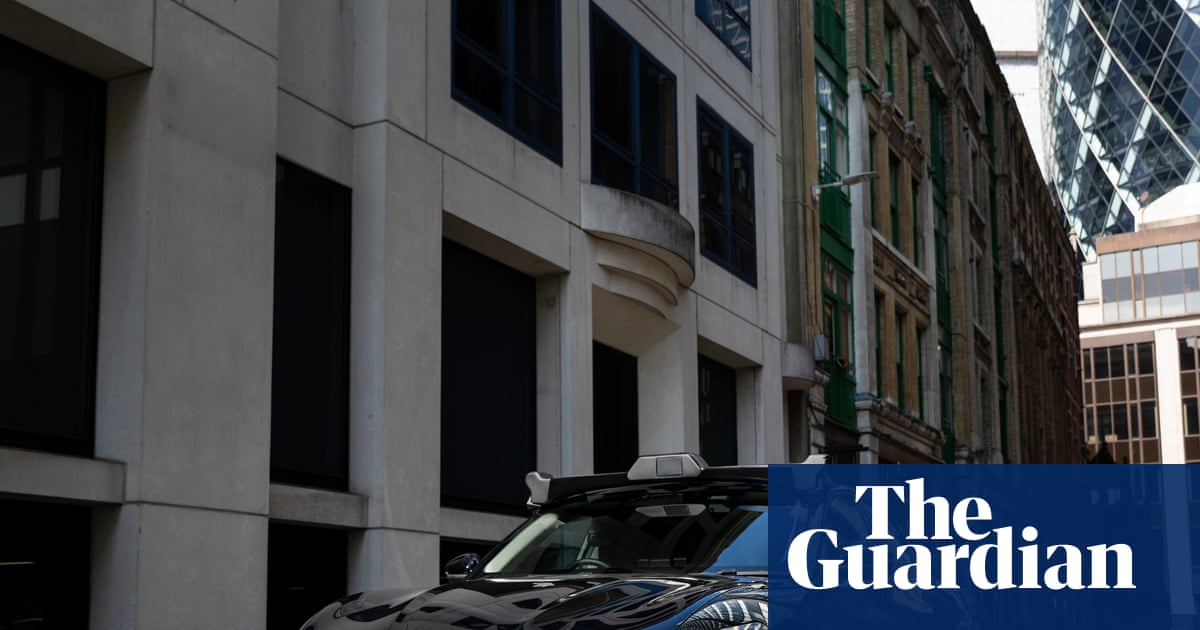
Londoners are now able to hire self-driving taxis for the first time, after rides in Wayveâs autonomous vehicles were added to the Uber app on Thursday.
The chances of landing a robotaxi on request immediately are slim, with only 15 vehicles so far licensed. That contrasts with the more than 100,000 private hire vehicles in the capital â roughly the same number of Uber customers who have registered to take autonomous rides.
The cars will still come with a licensed human driver sitting in the front seat, ready to take over the controls should the need arise.
Transport for London last month licensed Uber and the UK tech company Wayveâs modified Ford Mustang cars as private hire vehicles, whose conditions still require a safety driver supervising.
Regulatory approval for vehicles in fully autonomous operations without a safety driver needs to be granted under a separate government process and agency, the Driver and Vehicle Standards Agency, and is now seen as unlikely this year.
Nonetheless, Thursdayâs launch marks a significant milestone and has allowed Uber to steal a march in the race by tech companies to bring driverless taxis into London, seen as a crucial market for a wider European rollout. Google-owned Waymo and the Chinese company Baidu are testing their robotaxis in the UK capital.
Alex Kendall, the chief executive and co-founder of Wayve, said he was proud to introduce the companyâs AI Driver technology to the public for the first time in London, âour home city and one of the most complex driving environments in the worldâ.
Kendall said the technology was âstill maturingâ but robotaxi services without a safety driver would come, although he declined to predict exactly when: âI donât want to put a timeline on it, but weâre pushing as fast as we can.â
He said Wayve would be moving to âscalable manufacturer-produced vehiclesâ â new Nissan Leaf robotaxis with its technology â and needs to âvalidate the safety metrics on that platformâ, as well as secure regulatory approval.
âWeâre working on all three in parallel. As soon as they come together, weâll launch [fully] driverless services,â Kendall said.
Wayveâs self-driving technology is based on an AI learning model rather than the mapping used by rivals such as Waymo.
On a brief autonomous test drive with the Guardian in Westminster this week, all passed smoothly, with Kendall notably pleased by the car deciding to pull away again and re-park after stopping in front of gates that other cars were attempting to pass through. âThat was quite human-like â really cool,â he said. âWeâve done a lot work to make sure the car can park in appropriate spots that are socially acceptable.â
The cars will be hailed and unlocked through the Uber app. The driver will introduce themselves with an appropriately robotic script, explaining that they will no longer speak during the ride but can be requested to take over control of the vehicle if the customer prefers.
While they will be the first self-driving cabs for hire in London, fully driverless services are in operation in many cities worldwide, primarily in the US and China, as well as the United Arab Emirates.
after newsletter promotion
Uber partnered in launching Europeâs first commercial robotaxi service earlier this summer in Zagreb, Croatia, with a human driver onboard as in London.
Sarfraz Maredia, the head of autonomous mobility at Uber, said the London launch was âa major milestone in scaling safe, accessible AV technology in a city with some of the worldâs most complex roadsâ.
He said: âThe benefit for consumers should be, over time, that itâs both safer and cheaper. Today, nobodyâs able to operate AVs cheaper than a traditional human-driven ride, so thatâs going to take a while to prove.â
Maredia said Uber had heard concerns from drivers but said he believed they would not be put out of work: âOne of the most common ones we hear from our drivers is: âHey, I drive in this city and itâs very complex, and I donât think this product is going to be able to compete with me anytime soon.ââ
He added: âWe always want Uber to be a platform where both human drivers and AVs can operate, and because the market and our business are still growing here we think thatâs going to be true for a long time.â
Heidi Alexander, the transport secretary, said: âThis is a major milestone for the future of transport in London, as British innovation brings this technology on to our roads and gives passengers more choice.
âTodayâs announcement further cements Wayveâs status as a technology trailblazer here in the UK, and highlights how British innovation is helping drive investment and growth in transport.â
David McMullen, a senior organiser at the GMB union, said: âWith hundreds of thousands of people employed to drive every day, we need to be really careful with the rollout of driverless cars unless we are prepared to see unprecedented levels of social and economic disruption.â










Leave a Reply