
[ad_1]
On the morning of 6 July, an email went out from Asha Sharma, the chief executive of Xbox, to all of the divisionâs employees around the world. Under the headline âResetting Xboxâ, it announced the most significant restructuring in the history of Microsoftâs console business: 3,200 staff would be laid off throughout the financial year to 2027, and 1,600 of those roles would be eliminated immediately.
An hour later, at studios throughout company, the Teams meeting invites started arriving. âIt was a virtual call with our studio manager,â says Anne Barrett, who was laid off from Bethesda Game Studios Austin. âAll of our cameras and microphones were turned off so we werenât able to say anything or react to anything. We were just brought in, told the news and it was like: âYou guys are going to lose access to your Slack channel.â So you saw a flurry of goodbye messages before everything was just shut off.â
This, it seems, was the routine, at least at studios in North America: a Teams call with a studio head, a prepared statement read, then a warning about Slack (the group messaging app widely used at game development studios). Emails, the staff were told, would be turned off a few days later. âWeâre primarily a remote studio, so Slack is the main mode of conversation with our teammates,â says Morgan Goin, who worked at ZeniMax Online Studios. âAll through the morning, everyone was sending their goodbyes ⦠âHey, itâs been great working with you. Hereâs my contact information. Iâve loved working here. I will miss all of you.ââ Then silence.
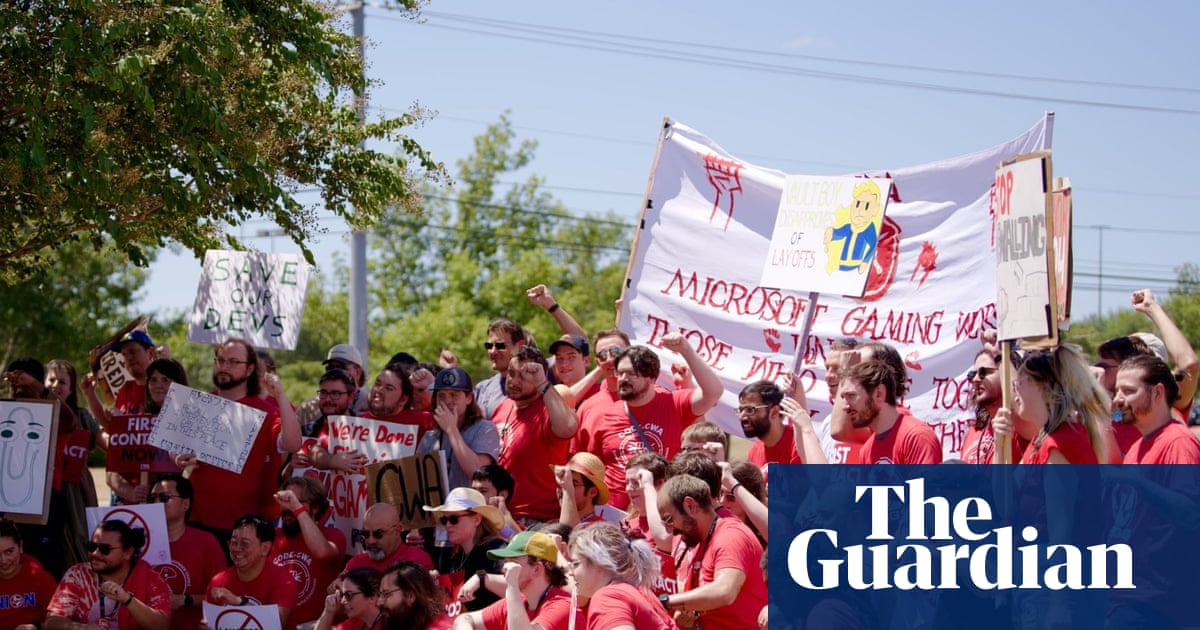
Bethesda Games Studios and Zenimax Online Studios were unionised in 2024 and both Goin and Barrett are on the bargaining committees for their respective studios, currently in talks with Microsoft. In the US, the Worker Adjustment and Retraining Notification (WARN) act is a federal law that requires companies with 100 or more employees to give its workers 60 daysâ notice before major closures or mass staff layoffs. Consequently, affected staff at US studios will be paid until 4 September. Union reps at Bethesda are undertaking a bargaining process with Microsoft to negotiate severance packages and any benefits owed, and is attempting to get at least some affected members re-employed. Rallies are taking place outside studio buildings across North America, with the Bethesda union seeking support from gamers via social media.
Staff say rumours had been circulating about a new wave of lay-offs for several weeks, and that they saw the Bloomberg article on 10 June warning of coming job cuts. âThere was an impending sense of doom, and it was like, man, is it going to be us?â says Barrett. âWe thought we were safe. I mean, Bethesda Games Studios is Skyrim, itâs Fallout. We have really highly anticipated stuff coming out. We thought that the work we were doing was going to keep us safe. And instead, we got brought into a meeting that was two minutes long, to end, in some cases, decades of career at the company. It was just devastating.â
âI remember, I laughed the whole day because I was in complete disbelief,â Barrett adds. âI was like, thereâs no way theyâre doing this. Thatâs how I processed it. Some of my co-workers were just devastated. I mean, breaking down. They did not understand what was going on. We had people who were just in really dark places. I think it hit me probably the next day. I felt like, wow â I just spent seven years doing all this. In college, people called me Bethesda because it was my dream to work here. And that was just ⦠gone.â
This is what doesnât get reported with the statistics of mass redundancies: the sheer human cost of it. âIâm very tired, my sleep schedule is all kinds of messed up, my eating has not been great,â says Goin. âI have to ask myself daily: have you had enough food and water? Have you had enough sunlight? When was the last time you took a shower? Weâre doing the depression symptoms, thatâs whatâs happening. I feel like Iâm grieving.â
Simon Préfontaine has a similar story. Previously a designer at Bethesda Game Studios Montreal, he is a single father concerned about the future without work, and without the health insurance his job came with. âItâs very stressful,â he says. âIâve heard of other people who have been laid off for over a year and havenât been able to find work. I know Iâm not the only single parent in the Montreal studio, I know there are people that have health issues.â But as with Goin, it is about more than financial stability. âIt might seem like an overstatement or a dramatisation, but I do feel like I went through the stages of grief. You work with these people for years and years and years, and then suddenly you donât get to see them any more.â
What has been most bewildering to staff is that there seemed to be no structure to the layoffs, no clear reasoning behind who was affected. âIâm on the character art team, and we lost two people who had been there for decades,â says Alex Nguyen, a union bargainer still employed at Bethesda Games Studios Dallas. âThey did everything that was asked, they were very passionate, they were great at their jobs. They worked on all this stuff that made our creatures, characters and armour feel real. Outstanding employees. It never made any sense.â
It is likely, after all that, there will be ramifications for games being produced at these studios â including content delays and project cancellations. Id Software, creator of Doom and Quake, lost 136 staff in the cuts â a majority of its workforce. One staff member affected, VFX artist Derek Best, claimed in a LinkedIn post that the developer had been relegated to âsupport studio sizeâ.
Barrett makes a similar assertion about Bethesda, where the redundancies have been less severe but where key staff have been affected. âI donât know how you create games at the quality level we were without the institutional knowledge thatâs been lost. We have proprietary tech. Our titles have a very well-known visual identity. And when you lose the people who built the tech, when you lose the people who were improving it, you canât just throw new people at that problem, right? You canât replace an artist with someone brand new and say: âNow replicate what they were doing 15, 20 years ago.â The company has said that they can do it. I disagree.â
Nobody knows what happens next. Barrett could only provide a brief statement on how the unionâs talks with Microsoft are faring: âEffects bargaining continues with each side exchanging counterproposals. In their counter, the employer has not made enough substantial movement to care for the very real consequences impacted members are facing (loss of employment; loss of income; and disruption of benefits for their families). We (the union) have indicated that we are prepared to work toward an agreement but we cannot accept a proposal where the burden of compromise falls almost entirely on the employees.â
A Microsoft spokesperson provided the following statement on the bargaining process: âEffects bargaining for our union-represented ZeniMax colleagues is under way and on track, and we have offered severance terms comparable to the generous package provided to our non-union represented colleagues, including up to 39 weeks of severance, six months of company-paid Cobra [Consolidated Omnibus Budget Reconciliation Act], and 16 weeks of outplacement support. We are committed to reaching an agreement that supports impacted colleagues as they move forward.â
At least 1,600 more redundancies are coming at Xbox studios as the âresetâ of the division continues. During that time, there will likely be mass lay-off events at other large companies in the industry. All of the staff I spoke to echoed a familiar feeling about mainstream games development â that something has gone drastically wrong and that mass redundancies point to a wider malaise. âPublishers have to be prepared for multi-year development cycles,â says Nguyen. âIf that cost is too high, or those timelines are too long, then the game needs to scale back in some way. That might mean more indie and AA games and fewer blockbuster titles. What doesnât work is investing in a long-term game product, and expecting profits on a yearly basis.â
Barrett concurs. âMy view of the industry has definitely been damaged,â she says. âThereâs been a loss of sight over why AAA games were so valuable to players. It wasnât just that they were big and shiny. It was that [the studios] had the resources to invest in creativity. What I see now is the same formula over and over and over again. In any entertainment industry, if you do that enough times, people get tired of it. I would love for us as an industry to get back to actually being creative and investing in that creativity.â
[ad_2]
Source link











Leave a Reply